
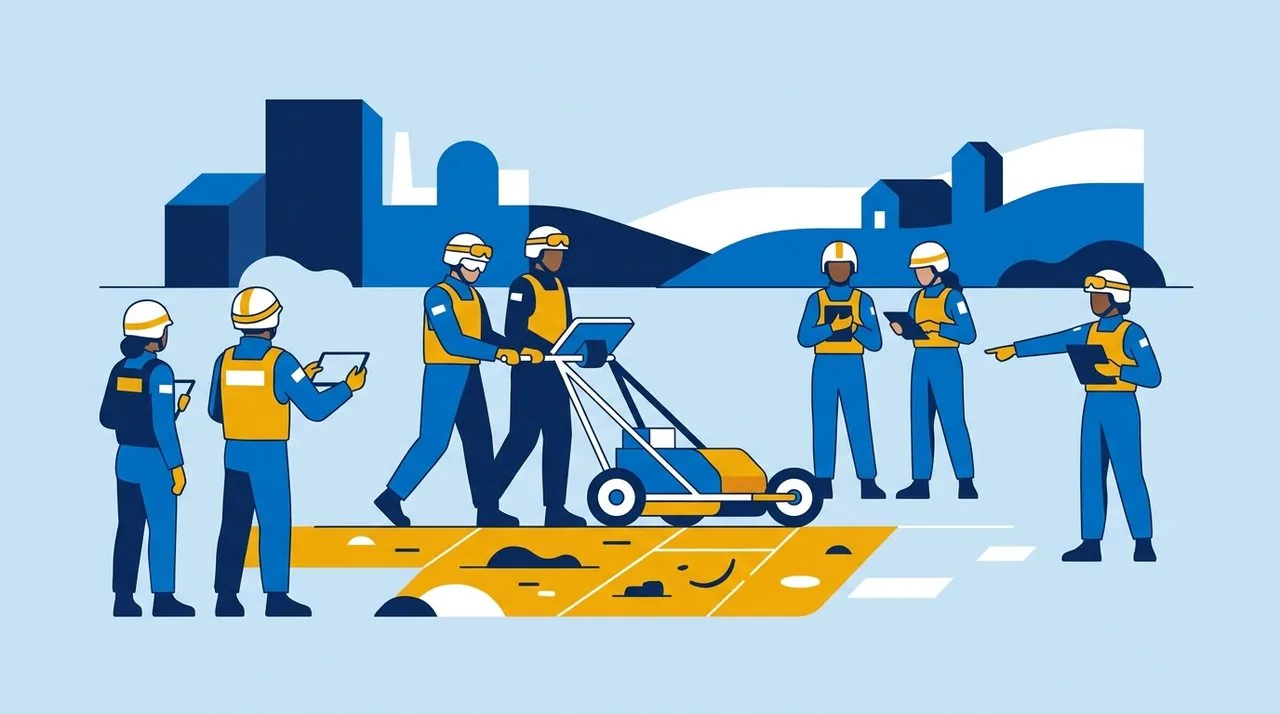
Bringing life back to de-occupied territories begins with training qualified specialists.
As of late 2025, the problem of mine contamination remains one of the greatest challenges for community recovery. According to specialized organizations, colossal areas of agricultural land, forests, and infrastructure facilities require clearance. Humanitarian demining is often perceived by society through the lens of heavy machinery—specialized vehicles that grind up the soil. However, no machine can operate autonomously, and the final decision regarding a site's safety is always made by a human.
The main bottleneck in the process of restoring security is not a lack of funding or international attention, but a shortage of personnel. The training system for humanitarian demining specialists is operating at the limit of its capabilities. To meet current needs, the number of certified mine action operators, sappers, geographic information system (GIS) analysts, and paramedics must be multiplied. The problem is that this process cannot be scaled instantly: high-quality training requires time, specialized training grounds, and experienced instructors.
A modern mine action specialist is not just a person with a metal detector and a probe. They are highly qualified professionals who understand the operating principles of complex electronic systems, know how to analyze spatial data, and can operate robotic complexes. The transformation of the profession demands entirely new approaches to the educational process.
The Evolution of Training: From Basic Skills to Technology Management
To accelerate the pace of territory clearance without compromising quality and safety, training centers are forced to revise their classic programs. The training process for a modern humanitarian demining specialist now consists of several interconnected levels, where technology plays a key role at each stage.
Basic Protocols and Threat Identification
The foundation of the profession remains unchanged. At this stage, future specialists study the International Mine Action Standards (IMAS), types of explosive ordnance, and the rules for handling them. The main focus is on personal safety, understanding the marking of hazardous areas, and the ability to provide first aid. Without perfect mastery of this knowledge, transitioning to working with equipment is impossible.
Non-Technical Survey and Aerial Reconnaissance
The most time-consuming stage of demining is finding the exact boundaries of contaminated areas. Instead of walking the territories on foot for weeks, modern specialists learn to use unmanned aerial vehicles (UAVs). Training includes piloting drones equipped with multispectral cameras, magnetometers, and thermal imagers. This allows for the safe detection of soil surface anomalies and significantly narrows down the area requiring direct intervention by sappers.
Data Analysis and Digital Mapping
The information collected from drones requires proper processing. Specialists are taught to work with geographic information systems (GIS). They create accurate digital maps of minefields, classify identified threats, and develop optimal routes for heavy demining machinery. This stage transforms the sapper into a data analyst, whose accuracy determines the effectiveness of the entire subsequent operation.
The transition to technological demining requires constant updating of the material and technical base of training centers. The use of drones significantly reduces the risks to personnel's lives, as it allows for remote reconnaissance. However, the cost of such equipment and the lack of qualified instructors capable of teaching the specific use of UAVs for humanitarian purposes slow down the training of new groups.
The public sector and humanitarian organizations are taking on a significant share of the responsibility for resolving this crisis. They bring in expertise, purchase training equipment, and create advanced training programs for those already working in the field. The synergy between the public sector and non-governmental organizations makes the educational process more flexible and adaptable to the real conditions in de-occupied territories.
The Yellow-Blue Foundation actively invests in solving the personnel problem by supporting educational initiatives. We provide funding for training programs for humanitarian demining specialists, placing a special emphasis on the implementation of innovations. The Foundation supplies training centers with modern unmanned systems and supports courses where future mine action operators gain practical skills in non-technical survey of territories using UAVs. This makes the process of clearing Ukrainian lands faster and, most importantly, safer for people.
The need for mine action specialists will remain relevant for decades. Creating a sustainable system for their training is an investment in the country's long-term security. The more qualified operators, analysts, and UAV pilots enter the fields, the sooner farmers will be able to sow their lands, and children will be able to safely attend schools in restored communities.
The quality of education in this field is directly measured by the civilian lives saved. Therefore, supporting training programs, providing them with modern equipment, and implementing the latest technologies is a priority task for the entire humanitarian sector.